


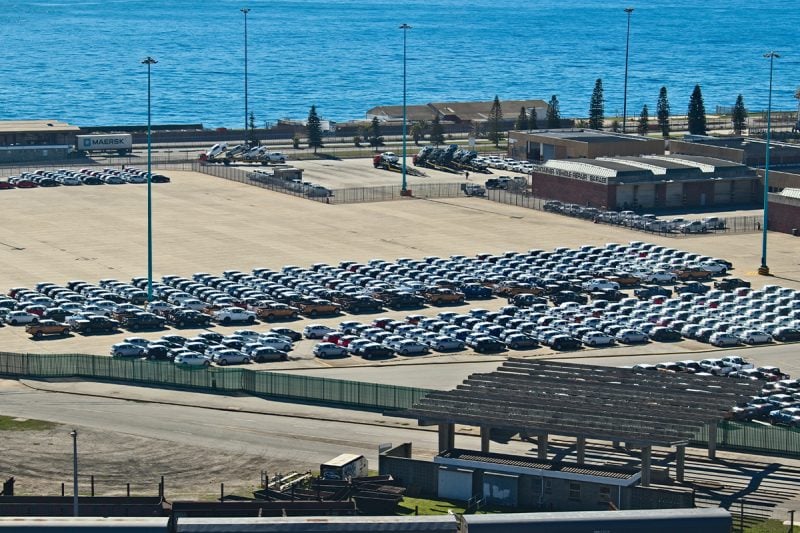
South Africa’s automotive industry is increasingly looking to the rest of Africa as a future growth market after vehicle exports to African countries recorded strong growth in 2025, helping offset rising uncertainty in traditional export destinations such as Europe and the United States.
According to new figures released by National Association of Automobile Manufacturers of South Africa (Naamsa), vehicle exports from South Africa to African markets rose by 36.4% in 2025 to 35,371 units, up from 26,200 vehicles in 2024.
The growth reflects increasing efforts by South African automakers and component manufacturers to position the continent as a long-term expansion market under the African Continental Free Trade Area (AfCFTA), particularly as Europe accelerates the transition away from internal combustion engine vehicles.
Despite the strong growth rate, African markets still account for a relatively small share of South Africa’s total automotive exports. Vehicles shipped to the rest of Africa represented less than 9% of total exports in 2025, while the European Union and the United Kingdom continued to dominate export demand. Around 80% of South Africa’s vehicle exports still went to Europe and the UK last year.
Industry stakeholders warn that this reliance could become increasingly risky as European governments move toward banning sales of petrol and diesel vehicles over the next decade in favour of electric vehicles.

South Africa currently does not manufacture fully electric vehicles at commercial scale, although several manufacturers have introduced hybrid production. The automotive industry has repeatedly called for stronger government incentives to support electric vehicle manufacturing and battery value chains.
At the same time, many African countries continue to rely heavily on internal combustion engine vehicles, creating a potential medium-term opportunity for South African manufacturers.
Countries including Ghana, Kenya, Nigeria, Egypt, Algeria and Côte d’Ivoire are currently developing automotive policies aimed at expanding local assembly and industrial capacity, in some cases with support from South African industry players.
South African automotive component manufacturers are also targeting African expansion opportunities. Exports of automotive components to African markets increased to R22 billion in 2025 from R21.5 billion the previous year, while combined exports of vehicles and components to the continent rose to R49.5 billion.
Industry projections suggest that vehicle manufacturing across Africa could potentially increase from approximately 1.23 million units in 2025 to between 3.5 million and 5 million units by 2035 if AfCFTA implementation accelerates and regional industrial policies improve. New vehicle sales across Africa are also expected to expand significantly over the same period.
However, used vehicle imports remain a major obstacle to growth. According to Naamsa’s Automotive Trade Manual, used vehicles still account for roughly 85% of vehicle sales across Africa, limiting demand for new locally assembled vehicles.
The industry is also facing pressure from global trade shifts and increased competition from Chinese automakers. Chinese vehicle brands have rapidly expanded their presence in the South African market by offering lower-cost models and longer warranty packages targeted at price-sensitive consumers. Chinese automakers increased their share of South Africa’s passenger vehicle market from 11.2% to 16.8% in 2025.
Meanwhile, South Africa’s automotive exports to the United States declined sharply in 2025 amid changing trade conditions and tariff pressures. Exports to the US market fell by 29% in value terms, contributing to growing industry concerns about long-term export diversification.
Trade experts argue that stronger regional integration under AfCFTA could help African economies develop more balanced industrial value chains instead of relying mainly on raw material exports.
AfCFTA Secretary-General Wamkele Mene recently warned that rising global protectionism and geopolitical fragmentation make deeper African economic integration increasingly important for the continent’s long-term industrial resilience.
Former South African trade minister Rob Davies has also argued that Africa’s automotive sector must move beyond simple export growth and focus on broader industrial participation across the continent to ensure long-term sustainability.
South Africa exported vehicles to 154 countries in 2025, with total automotive exports reaching a record R291 billion. Vehicle export volumes rose to 414,271 units during the year.
Keyword:
Meta Description: