


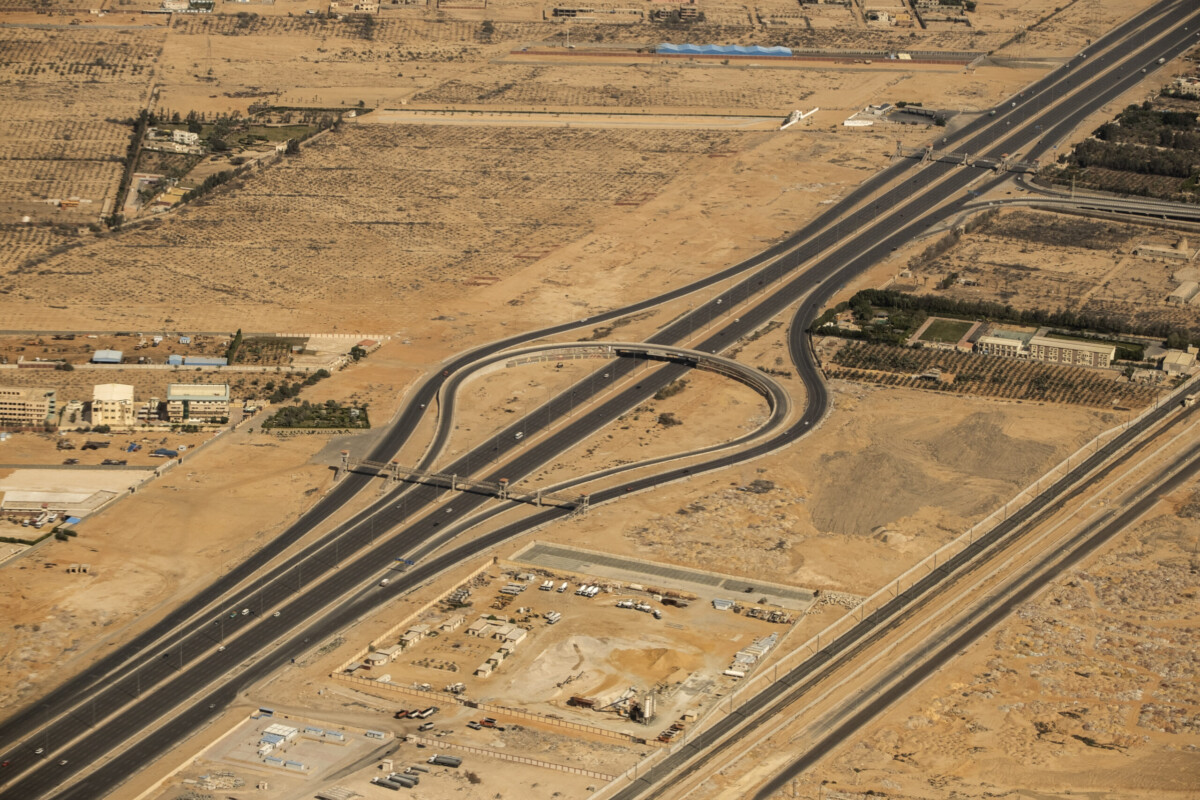
Image: Amir MAKAR / AFP
Egypt is advancing its ambition to help reconnect Africa from north to south through a 10,000-kilometre highway linking the Mediterranean to the continent’s southern tip. In November 2025, Deputy Transport Minister Hossam El-Din Mustafa announced that roughly 80% of the Cairo–Cape Town Highway had been completed. After departing Cairo, the route runs through Sudan, Ethiopia, Kenya, Tanzania, Zambia, Zimbabwe, Botswana and South Africa before reaching Cape Town.
Egypt is financing and delivering the sections within its own borders, while the broader corridor forms part of the African Union’s Trans-African Highway framework. Each participating country is responsible for constructing and funding its respective stretch, often with backing from multilateral lenders or bilateral partners. As a result, while significant progress has been made, the highway is not yet fully continuous, with interruptions in conflict-affected areas such as Sudan and parts of the Horn of Africa.
Around the same time, Cairo unveiled a complementary 1,720-kilometre overland link to Chad via Libya. Budgeted at approximately 24 billion Egyptian pounds (about $510 million), the project is divided into national segments across the three countries. It is designed to open new trade routes into the Sahel and provide landlocked Chad with improved access to Mediterranean and Atlantic markets. As with the north–south corridor, Egypt is funding its domestic sections while construction beyond its borders depends on local financing and partners.
Both initiatives align with the AU’s Agenda 2063 vision of improving continental connectivity. Strategically, Egypt aims to position itself as a north–south gateway, linking fragmented African markets and reducing reliance on maritime chokepoints. However, the durability of this ambition will depend less on paving roads and more on managing the political and security risks that shape the regions the corridors traverse.

The routes cross some of Africa’s most fragile political environments, including war-affected Sudan, divided Libya, volatile Chad and an embattled Ethiopia. According to Joseph Sany, formerly of the United States Institute of Peace, large-scale infrastructure projects often carry geopolitical symbolism. Egypt, he argues, views such corridors as signals of leadership, particularly as countries like Morocco expand their own influence through major Atlantic-facing port investments.
Morocco has developed deep-water facilities such as Nador West Med and Dakhla Atlantic Port to strengthen trade links with West Africa and the Sahel. Meanwhile, Gulf states have consolidated logistics positions along the Red Sea and East African coast. Egypt’s approach differs in that it prioritises inland connectivity over maritime dominance.
Analyst Youssef Cherif of the Columbia Center for North and West Africa suggests the strategy also reflects Cairo’s broader geopolitical recalibration. With instability in Sudan and tensions with Ethiopia reshaping its eastern and southern neighbourhoods, Egypt is seeking to diversify its regional options and strengthen its role as a bridge between the Mediterranean, the Red Sea and sub-Saharan Africa.
Recent disruptions in the Red Sea have reinforced this calculus. Attacks by Yemen’s Houthi movement since late 2023 sharply reduced shipping flows, and in 2024 Egypt reportedly lost more than 60% of its usual revenues from the Suez Canal. Overland alternatives therefore offer both economic and strategic hedging.
Despite ongoing construction gaps, experts note that economic gains do not require full completion. Functional segments in countries such as Egypt, Kenya and South Africa already generate value. Improved connectivity can integrate rural regions into national and cross-border markets, creating new rural–urban linkages even before the corridor operates end-to-end.
Yet physical infrastructure alone is insufficient. Comparisons are often drawn with the Dakar–Lagos coastal corridor in West Africa, which benefits from relatively stronger regional integration. As Alberto Rizzi of the European Council on Foreign Relations argues, completing a road is only the first step. Without harmonised standards, streamlined customs procedures and coordinated logistics services, non-tariff barriers and protectionist practices can undermine trade flows.
Transport costs along many African north–south corridors remain significantly higher than in Asia or Latin America, partly due to fragmented customs systems and security-related delays. This helps explain why intra-African trade accounts for only about 15% of the continent’s total trade, despite tariff reductions under the African Continental Free Trade Area.
Regional blocs such as Economic Community of West African States have made more progress by implementing common tariffs and free movement protocols. By contrast, integration efforts in North Africa, including the Arab Maghreb Union, have stalled, with intra-regional trade remaining minimal.
Ultimately, the success of the Cairo–Cape Town corridor will depend on whether it catalyses economic ecosystems along its route. That means supporting entrepreneurs, building agro-industrial and manufacturing hubs, and fostering value chains that connect rural producers to regional markets. Continental programmes such as the AU’s Programme for Infrastructure Development in Africa envision corridors as anchors for such transformation.
The Egypt-led highway will therefore be judged not by kilometres completed, but by whether it changes the structure of trade — influencing what goods move, who participates in commerce and where value is created across the continent.