


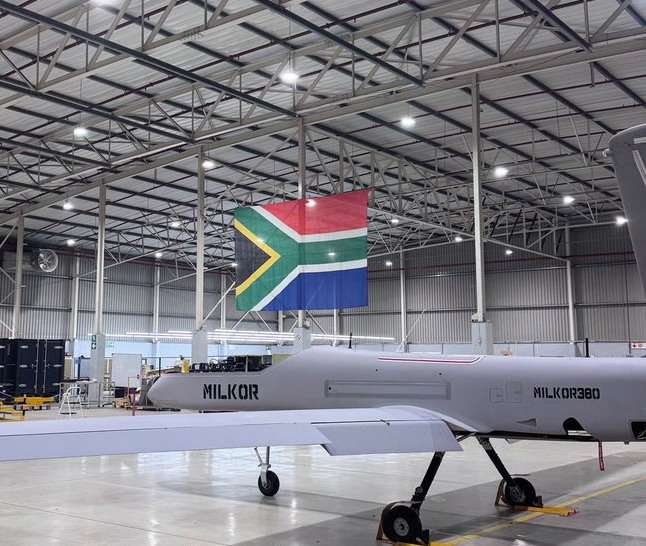
The South African government wants to drive growth and job creation. The local defence industry has existing capabilities that can be exploited to assist. There are two elements that would need to be satisfied if the country wanted to use the defence and related security industry to assist in leveraging a growth strategy. The first element would be prioritising exportability. The second is promoting local capability development for use in local applications. What would be needed is a new local mindset of “procure to export”, while protecting local technology developments.
The South African defence industry (SADI) needs to focus on Exportability. This is about maximising government’s strategic growth goals via defence export relationships with other nations. Maximising Exportability of defence and security products can increase South Africa’s international influence, reduce unit prices to local defence and security entities, improve the viability of South African manufacturing infrastructure, increase and diversify supply chains with the resultant increase revenues.
The National Conventional Arms Control Committee (NCACC) controls all conventional arms related issues and is primarily responsible for the implementation of the obligations under the Wassenaar Arrangement.
Foreign trade is vital for South African defence sector business to succeed internationally by exporting products, technology and services. The NCACC is responsible for maintaining policy to maximise exports of the military capabilities developed by the SADI and embedding consideration of Exportability across defence. There are several elements that guide arms control in South Africa, but the authorization of arms transfers is ultimately a political decision. The arms control act intimates that the arms control domain should be guided by the promotion of certainty, predictability, responsibility, accountability, regularity, and objectivity. The political end decision point then is in contradiction to this aim. For defence product exportability to be successful, South Africa should follow the approach of other countries with successful defence industries. Local (SADI) solutions will be exported unless there are really good grounds for not doing so.
Who might be potential customers?

NCACC annual export reports over the last 15 years highlight that the SADI exports to an average of 115 countries per year. Over 40 of these countries are in Africa, making South Africa the biggest supplier to Africa by country coverage. SADI is not the biggest by volume of arms. The Stockholm International Peace Research Institute (SIPRI) recently published arms transfer information for 2014 – 2024. The data has been visually processed by The Outlier.
Russia, which supplies arms to 23 African countries, exports the most arms by value to Africa. It has deep roots with many of these countries dating back to independence struggles and Cold War-era conflicts. The 2024 SIPRI report highlights that the Russian share of global arms exports has decreased over 64% between 2020-24.
China, despite transferring less advanced military technology than its competitors, has the widest reach other than South Africa — supplying arms to 36 African countries.

The Chief of the South African National Defence Force (SANDF) has announced that the Special Operations Force (SOF) concept will be unlocked into the future. This means product development to meet the needs of the new force application. What is needed is a procure to export philosophy from the start of the change in approach. The focus needs to be on maximising development returns. The SADI has the opportunity to become a leader in product capabilities that meet the SOF needs, especially for the African continent. South Africa is one of only seven African countries that currently sell arms internationally.
If the SADI is selling into Africa, it means the country must exercise capability protection. Capability protection covers protecting the operational advantage derived from new SOF capabilities and to ensure the freedom of action to acquire the equipment needed and use it as the SANDF choose. The UK Ministry of Defence is promoting this approach, and they have highlighted two challenges related to capability protection. Firstly, reducing the risk that the newly developed SANDF capabilities used on operations may be unexpectedly overmatched, due to adversaries having accessed and intrusively analysed them to develop countermeasures or copies. Secondly, realising tangible benefits by enabling exportability and reducing the chance that capabilities can be replicated for commercial advantage.
Achieving exportability requires consideration of capability protection. Speed to market is going to be critical. It should be possible to reach a balance between national and international legal obligations, and export market requirements.
South Africa is 21st on the list of international exports of defence equipment over the period 2018-2023, currently 25th for the single year of 2024. This is no mean feat, as South Africa is the country with the smallest defence budget while maintaining a fully established defence industry in multiple sectors, namely Cyber, Land, Air, Sea & Security (CLASS).
What is in the realm of possibility if there was true government support? With the correct interventions, the defence industry could easily grow fivefold from its current levels. The focus would be on re-establishing the main equipment for the defence force, while expanding into the export market. A stretch target would be to grow the SADI to supply 1% of global arms and have 2-4 companies in the SIPRI top 100 international defence companies. This would place South Africa within the top 15 biggest arms exporters.

This is all possible. Türkiye has expanded its arms supply market in the space of 20 years with a focused government initiative starting with a decree that all military goods be locally procured. They have since expanded to focus on export opportunities.
As a top 15 arms exporter, South Africa would be in impressive company, especially as these are all technology development hubs.
The ultimate outcome of a procure to export approach is that South Africa will be able to reclaim credibility through the SANDF in meeting constitutional and regional obligations.
Written by James Kerr, Orion Consulting CC, which provides Market Entry Strategy and Bid & Proposal services to the Aerospace & Defence related industry and assists international SME mission system product suppliers to gain traction in South Africa.