


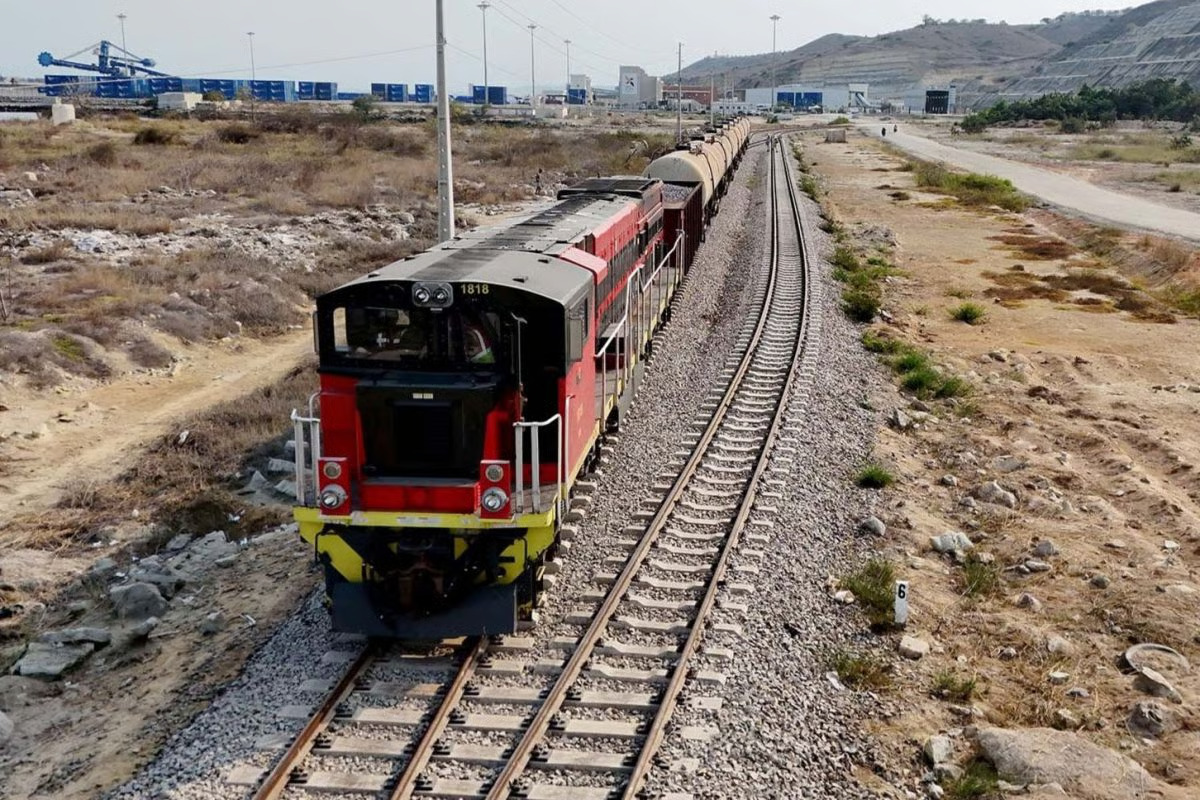
The Africa Finance Corporation (AFC) has named preferred bidders to construct a new 515-kilometre railway line through Zambia, marking a significant step forward for the US-backed Lobito Corridor, which aims to improve the transport of copper, cobalt and other critical minerals to Angola’s Atlantic coast.
Italy’s Webuild, Portugal’s Mota-Engil and Turkey’s İçtaş have been selected for Zambia’s railway section. For the Angolan section, Mota-Engil and Brazil’s Odebrecht Engineering and Construction were chosen. AFC said contract negotiations are expected to begin in November 2026 and last between eight and 12 weeks.
The wider project includes upgrading Angola’s existing railway infrastructure and developing the new Zambian route to strengthen connections between the mineral-rich Copperbelt region and the port of Lobito. An environmental study has estimated that construction of the new route could cost as much as $5 billion, although AFC chief executive Samaila Zubairu declined to confirm a final figure while negotiations remain ongoing.
The corridor has attracted international attention as Western governments and development financiers seek to establish alternative supply routes for critical minerals, which are essential to industries including electric vehicles, batteries and renewable energy.
Lobito Corridor Aims to Support African Industrialisation

AFC has rejected the suggestion that the corridor will primarily serve to export Africa’s raw materials. Zubairu said the project could stimulate industrial development across Zambia, Angola and the Democratic Republic of Congo (DRC) by improving transport links and creating opportunities for local processing and manufacturing.
He argued that exporting unprocessed minerals limits the economic opportunities available to producing countries, particularly in job creation and value addition.
AFC has previously highlighted research suggesting that parts of the battery production supply chain could be developed more cost-effectively and with lower emissions in the DRC than in countries such as China and Poland.
The corporation is also exploring an energy corridor to support industrial activity along the route. According to Zubairu, discussions are underway on power-line infrastructure that could transmit electricity from Angola, where an estimated 2 gigawatts of stranded hydropower capacity could potentially support businesses and processing facilities.
Improved access to reliable electricity could help attract investment into mineral processing and other energy-intensive industries, although the proposed infrastructure would require further development.
International Financing Advances the Project
The Lobito Corridor builds on the historic Benguela Railway, which transported minerals from central Africa’s Copperbelt to Angola’s Atlantic coast. Momentum to revive and expand the route increased in 2023, when the United States, European Union, Angola, Zambia and the DRC backed the initiative.
AFC had secured commitments for approximately one million tonnes of cargo annually as of April 2026. Italy has pledged financing support, while AFC has received letters of intent from Italian export credit agency SACE. The United States has said it has mobilised more than $4 billion in US investment for the project.
The African Development Bank approved a first tranche of $255 million for Zambia’s section of the corridor in August 2026. AFC has also been in discussions with at least 10 lenders to raise between $3 billion and $5 billion, with financial agreements targeted for completion in late 2027, according to Reuters reporting cited by Semafor.
The appointment of preferred contractors moves the project closer to formal construction agreements, although the final contracts and financing arrangements remain important milestones.
Local Participation Remains a Challenge
The selection of international contractors has also raised questions about the role of African construction companies in major infrastructure projects.
Zubairu said AFC prioritised firms with experience delivering large projects on schedule and within budget, as well as the financial guarantees required by lenders. He expressed hope that African companies would be better positioned to lead similar projects in the future.
Beyond the railway itself, AFC is developing financing mechanisms intended to channel more African pension-fund capital into infrastructure. The corporation has also announced a $1 billion risk-sharing programme with German reinsurer Munich Re covering short-term trade-finance exposures across 38 banks in 11 African countries.
For Zambia, the Lobito Corridor could improve access to international markets for copper and other minerals while creating opportunities for investment in logistics, energy and mineral processing. Its wider economic impact will depend on whether improved transport infrastructure is accompanied by local manufacturing, skills development and stronger participation by African businesses.