


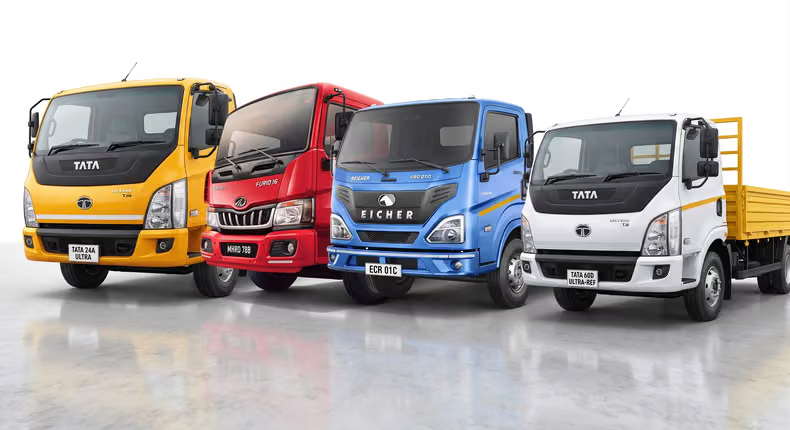
India’s push for improved access to Southern African markets is set to face an early test over automobiles, with New Delhi seeking lower tariffs while South Africa considers stronger measures to protect its domestic automotive industry.
India and the Southern African Customs Union (SACU) have agreed to begin negotiations for a preferential trade agreement covering South Africa, Botswana, Namibia, Lesotho and Eswatini.
The two sides signed terms of reference for the negotiations on Wednesday, reviving a process first proposed nearly two decades ago.
Formal negotiations are expected to begin within a month, with both parties targeting completion within one year.
India Targets Automotive Trade

Automobiles and components are expected to be among the products for which India seeks improved market access.
Indian automotive and component exports to SACU were worth approximately $1.7 billion in the financial year ended March 2026, making the sector India’s second-largest export category to the bloc after petroleum products.
India exported approximately $7.5 billion in goods to SACU during the period, while imports from the bloc reached $9.2 billion.
Total trade was therefore approximately $16.7 billion based on those figures.
India is also expected to seek improved access for pharmaceuticals, industrial machinery, electrical equipment, chemicals and textiles.
However, automobiles could prove considerably more difficult to negotiate because of the importance of South Africa’s domestic vehicle manufacturing industry.
India Dominates South Africa’s Imported Vehicle Market
India’s automotive position in South Africa has strengthened significantly.
Indian manufacturers supplied 219,796 light vehicles to South Africa in 2025, representing 56.2% of all light-vehicle imports into the country.
China was the second-largest source, supplying 91,326 vehicles and accounting for 23.3% of imports.
Together, India and China supplied approximately 79.5% of South Africa’s imported light vehicles during the year.
South Africa’s total light-vehicle imports increased by 28.6%, from 304,175 units in 2024 to 391,287 units in 2025.
Imported vehicles accounted for 69.1% of total light-vehicle sales, up from 62.7% a year earlier.
India has particularly strong positioning in smaller and more affordable vehicles, with manufacturers using the country’s production facilities as export bases for entry-level models targeting developing markets.
South Africa Considers Higher Import Duties
The negotiations come as South Africa considers increasing protection for its domestic automotive sector.
South African officials indicated during a parliamentary briefing in January that the country could increase the import duty on fully built passenger vehicles from approximately 25% to as much as 50%, which represents the ceiling permitted under its World Trade Organization commitments.
No decision has been announced to introduce a 50% tariff.
The figure represents the maximum duty available under South Africa’s WTO commitments rather than a new tariff currently in force.
Nevertheless, the possibility of higher duties creates a significant point of tension as India seeks preferential access for vehicles produced in its factories.
South Africa is simultaneously reviewing measures aimed at protecting domestic vehicle assembly and component manufacturing from rapidly increasing imports, particularly from India and China.
Balancing Consumers And Local Industry
The potential tariff increase also creates a difficult policy trade-off for South Africa.
Higher duties could provide greater protection for local vehicle manufacturers and component producers, but they could also increase prices for consumers.
This is particularly significant because Indian manufacturers have established a strong position in South Africa’s smaller and more affordable vehicle segment.
BMW South Africa CEO Peter van Binsbergen has warned that significant tariff increases could affect vehicle affordability and create unintended consequences for local manufacturers that depend on imported components.
South Africa therefore needs to balance industrial policy objectives with the need to maintain access to affordable vehicles for consumers.
Automotive Industry Remains A Major Export Sector
South Africa’s automotive industry is also heavily dependent on international trade.
The sector exported a record R291 billion worth of vehicles and components in 2025, while vehicle exports reached 414,271 units.
The industry maintained an automotive trade surplus despite the significant increase in imported vehicles.
At the same time, manufacturers face pressure to increase local content, maintain international competitiveness and prepare for the transition towards electric vehicles.
These factors make the India-SACU negotiations particularly important for South Africa’s automotive industry.
What India and SACU Want
India and SACU will negotiate across eight areas, including trade in goods, rules of origin, customs procedures, dispute settlement and sanitary and phytosanitary measures.
India’s Commerce and Industry Minister Piyush Goyal has indicated that New Delhi does not intend to aggressively target sensitive SACU sectors if the bloc similarly recognises sensitive industries in India.
The initial focus is expected to be on areas where the two sides are considered complementary.
For SACU, the agreement could provide greater access to the large Indian market, while member states will need to determine which domestic industries require protection from increased competition.
For India, improved access to Southern African markets could provide additional opportunities for its manufacturers and exporters.
South Africa Will Shape the Deal
Although India is negotiating with all five SACU members, South Africa will have a particularly significant influence on the commercial value of the agreement.
South Africa accounted for approximately $7 billion of India’s exports to SACU and $8.5 billion of India’s imports from the bloc during the year ended March 2026.
The automotive sector is therefore likely to become one of the most closely watched areas of the negotiations.
India wants lower barriers for vehicles and components, while South Africa is considering higher protection for an industry that remains an important source of manufacturing investment, exports and employment.
A Key Test for India-SACU Trade
The treatment of automobiles could become one of the first major tests of whether India and SACU can balance greater market access with domestic industrial priorities.
Lower tariffs could expand vehicle trade and potentially give Southern African consumers access to more competitively priced vehicles.
However, South Africa will also want to ensure that greater access to its market is accompanied by stronger local production, investment and value creation.
For India, the negotiations represent an opportunity to deepen its commercial relationship with Southern Africa and expand exports beyond traditional sectors.
For SACU, the challenge will be securing meaningful access to India’s market while ensuring that preferential trade does not undermine strategic domestic industries.
The outcome of the automotive negotiations could therefore set the tone for the wider India-SACU preferential trade agreement and determine how successfully both sides can turn stronger trade ties into broader industrial and investment opportunities.