


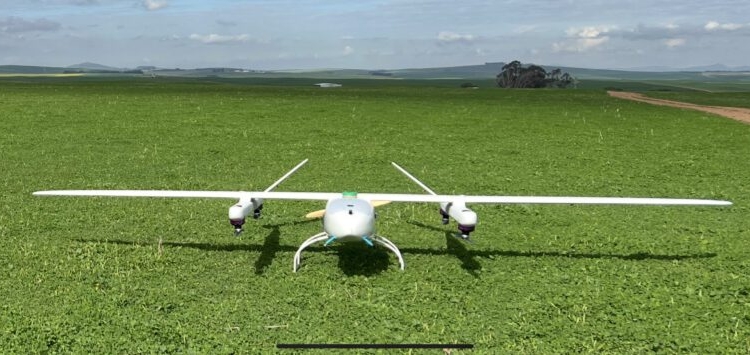
South African unmanned systems manufacturer ShadowfaxUAS has launched the SF45, a new long-endurance vertical take-off and landing drone designed to compete in the growing international market for persistent surveillance systems.
The Cape Town-based company says the SF45 is the first and largest of three new-generation unmanned aerial vehicles being developed from the company’s earlier SF30 platform.
The new aircraft has been designed with international demand in mind, particularly from customers seeking alternatives to Chinese-made drone systems.
The development reflects a major shift taking place in the global unmanned aircraft market.
Geopolitical tensions and concerns over supply-chain dependence have prompted governments and defence companies in Western markets to look more closely at where drone components are manufactured and how dependent their systems are on foreign suppliers.

ShadowfaxUAS said the war in Ukraine and increasing international polarisation were major factors behind its decision to develop an entirely new aircraft rather than simply modify the SF30.
The company said changing restrictions on Chinese-made drone hardware, including components and complete systems, highlighted the need for alternative supply chains.
That environment is creating an opening for manufacturers outside China.
For ShadowfaxUAS, the opportunity is not simply to replace individual components but to develop a platform designed around the requirements of customers seeking longer endurance and greater payload flexibility.
The SF45 is classified as a Group 3 UAV, with a maximum take-off weight of 40 kilograms and a payload capacity of up to 8 kilograms.
It has a wingspan of 4.3 metres and a datalink range of up to 150 kilometres.
When configured with a payload between 1.5 and 3 kilograms, the aircraft can remain airborne for up to 10 hours, depending on configuration. The company says this provides a sortie range of more than 1,000 kilometres, with a maximum operating altitude of 3,000 metres.
Those capabilities position the SF45 for persistent intelligence, surveillance and reconnaissance missions where operators require an aircraft capable of remaining airborne for extended periods.
The platform’s VTOL capability also offers an important operational advantage by allowing it to take off and land without requiring a conventional runway.
ShadowfaxUAS said customer requirements were another factor behind the redesign.
The company identified two broad groups of potential users: those requiring relatively lower-specification payloads for persistent surveillance and those looking to carry heavier or multiple payloads.
The SF45 was therefore developed with greater payload capacity and flexibility rather than simply extending the capabilities of the existing SF30.
For South Africa’s aerospace and defence industry, the launch represents an opportunity to participate in a rapidly developing international market.
The global drone industry has expanded significantly as unmanned systems have become increasingly important for surveillance, border monitoring, infrastructure inspection and other applications.
For African manufacturers, however, competing internationally requires more than developing capable aircraft.
Export markets increasingly place importance on supply-chain security, regulatory compliance, component traceability, technical support and the ability to provide reliable systems over their operating lifetimes.
That makes ShadowfaxUAS’s focus on developing an alternative supply chain particularly significant.
South Africa already has a long history of aerospace engineering and defence manufacturing, giving companies such as ShadowfaxUAS an industrial base from which to develop specialised unmanned systems.
The SF45 launch demonstrates how changing global trade and geopolitical conditions can create opportunities for manufacturers outside the traditional centres of production.
As governments and commercial operators seek to diversify their sources of drone technology, South African companies could find growing opportunities in markets looking for alternatives to Chinese platforms.
For ShadowfaxUAS, the challenge now is turning that market opportunity into international sales.
If it succeeds, the SF45 could become an example of how African engineering companies can move beyond supplying domestic markets and compete in specialised global technology segments.
The shift in the drone market is creating new export possibilities.
South Africa’s opportunity is to make sure its manufacturers are ready to capture them.