


Nigeria’s manufacturing sector has remained below 10% of gross domestic product (GDP) for more than a decade, raising concerns over the country’s industrial competitiveness despite repeated government reforms aimed at accelerating manufacturing growth.
The sector contributed 9.43% of GDP in 2015 but fell to 8.05% in 2025, according to data compiled from the National Bureau of Statistics and World Bank. The figures highlight what industry experts describe as a prolonged period of industrial stagnation.
Nigeria has introduced several measures to strengthen manufacturing, including business-environment reforms, Central Bank intervention funds, tax incentives and support for small and medium-sized enterprises. However, manufacturers continue to face high operating costs and structural constraints.
The removal of the petrol subsidy in 2023 further increased costs for many manufacturers, while the government’s National Industrial Policy 2025–2030, launched in 2026, has set an ambitious target of increasing manufacturing’s contribution to GDP to between 20% and 25% by 2030.
Nigeria Trails Major African Manufacturing Economies

Nigeria’s manufacturing performance also compares poorly with several major African economies.
World Bank data for 2024 put manufacturing value added at 15.27% of GDP in Morocco, 13.89% in Egypt and 12.80% in South Africa. Ghana recorded 9.84%, slightly ahead of Nigeria.
The gap is particularly significant given Nigeria’s large population and position as one of Africa’s biggest economies. Industry experts argue that a stronger manufacturing base is essential for creating jobs, increasing exports, reducing import dependence and improving economic resilience.
Dele Kelvin Oye, chairman of the Alliance for Economic Research and Ethics Ltd/GTE, described Nigeria’s performance as a “lost decade” for industrialisation.
He noted that manufacturing accounted for more than 20% of Nigeria’s GDP in the early 1990s, before gradually declining to its current level.
According to Oye, the sector remains heavily concentrated in food, beverage and tobacco production, leaving manufacturers exposed to supply-chain disruptions, foreign exchange volatility and weaker consumer purchasing power.
Power And Financing Remain Major Obstacles
Industry stakeholders say unreliable electricity remains one of the biggest barriers to manufacturing expansion.
High interest rates, poor transport infrastructure, multiple taxation, imported raw materials and limited access to affordable finance are also restricting manufacturers’ ability to invest and expand.
Muda Yusuf, chief executive officer of the Centre for the Promotion of Private Enterprise, said Nigeria’s manufacturing contribution has remained around 9% to 10% for most of the democratic era, despite successive industrial policies.
He argued that industrialisation remains critical to economic transformation, particularly through job creation, value addition and export growth.
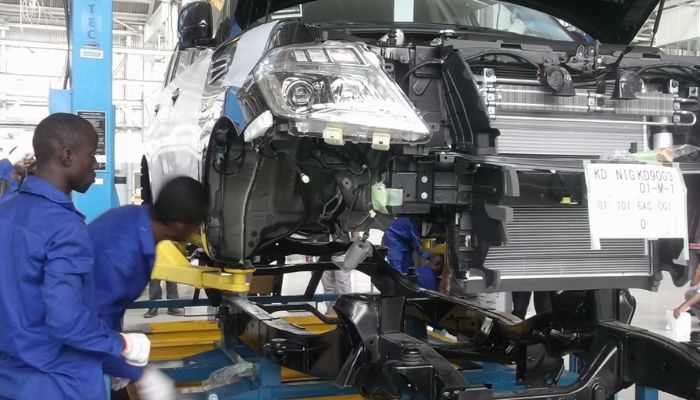
Yusuf also pointed to the decline of industries including textiles, tyres, batteries and automobile assembly, which has contributed to factory closures, job losses and greater reliance on imported products.
He called for faster power-sector reforms, improved rail infrastructure, stronger development-finance institutions and affordable long-term financing for manufacturers.
Government Faces 2030 Manufacturing Test
Nigeria’s National Industrial Policy provides a more ambitious framework for reversing the sector’s decline, but experts say implementation will determine whether the 20%–25% GDP target can be achieved.
Improving infrastructure, reducing the cost of capital, strengthening local-content policies and giving preference to locally manufactured products in public procurement could help create stronger domestic industrial capacity.
For Nigeria, the challenge is no longer simply developing manufacturing policies but turning those policies into sustained industrial growth. With the sector still contributing less than 10% of GDP, the government faces a significant task if it is to transform Nigeria into a competitive African manufacturing hub by 2030.