


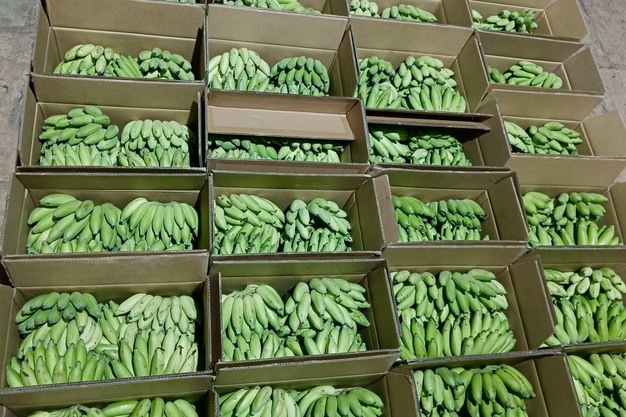
Across sub-Saharan Africa, banana producers are increasingly turning to processing as a strategy to reduce post-harvest losses and unlock new revenue streams, marking a shift toward value-added agriculture.
Post-harvest losses for fruits and vegetables in the region are estimated at 40% to 50%, driven largely by limited storage, weak logistics, and market volatility. To address this, growers are converting highly perishable bananas into shelf-stable products such as flour, purée, and chips—extending shelf life from a matter of days to several months.
In Kisii County, small-scale processing units are transforming overripe bananas into flour, enabling farmers to access wider markets and stabilise incomes. “Before, we were at the mercy of the market. Now we can hold value,” one grower noted.
Industry estimates suggest that processed banana products can increase export earnings by up to 42%, depending on product mix and access to regional and international markets.
Emerging processing hubs

Several countries are already demonstrating the potential of this model.
In Kisii County, Nyangorora Banana Processors produces banana flour, doughnuts, and porridge using supply from smallholder farmers.
In Mutasa District, a processing plant is aggregating bananas and supplying structured buyers, helping to formalise the value chain and reduce market fragmentation.
Meanwhile, in Ghana, Golden Exotics—which operates approximately 2,000 hectares—is expanding into processed products such as banana chips and purée for regional markets. In Angola, Novagro is integrating production and processing for exports to both African and European markets.
Trade integration driving opportunity
The African Continental Free Trade Area is expected to accelerate this transition by lowering tariffs and harmonising trade rules across the continent. With intra-African trade currently accounting for only 15% to 20% of total trade, processed agricultural goods are seen as a key growth area.
By increasing product shelf life and value, banana processing enables producers to participate more effectively in regional trade, while reducing reliance on fresh produce markets that are highly vulnerable to spoilage and transport delays.
Economic and social impact
Beyond export potential, processing is strengthening agricultural value chains. It increases unit prices, reduces waste, and creates jobs in processing operations, quality control, packaging, and logistics.
It also provides a pathway for smallholder farmers to transition from subsistence production to more commercially viable, market-linked systems.
Persistent challenges
Despite the progress, several constraints continue to limit scale. High transport costs, inadequate cold chain infrastructure, and unreliable power supply remain major bottlenecks across many production zones.
Production risks also persist, particularly from diseases such as Banana Bunchy Top Virus and Fusarium Wilt, which can significantly affect yields. In addition, access to processing technology and compliance with certification standards remain hurdles for smaller operators.
A blueprint for value addition
Even with these challenges, the growing adoption of banana processing reflects a broader shift in Africa’s agricultural strategy—from exporting raw produce to building resilient, value-added supply chains.
As infrastructure improves and trade barriers continue to fall under the AfCFTA framework, processed banana products are poised to capture a larger share of both regional and global markets.
The model emerging across countries—from Kenya to Zimbabwe, Ghana, and Angola—offers a scalable blueprint not only for bananas, but for transforming other agricultural value chains across the continent.