


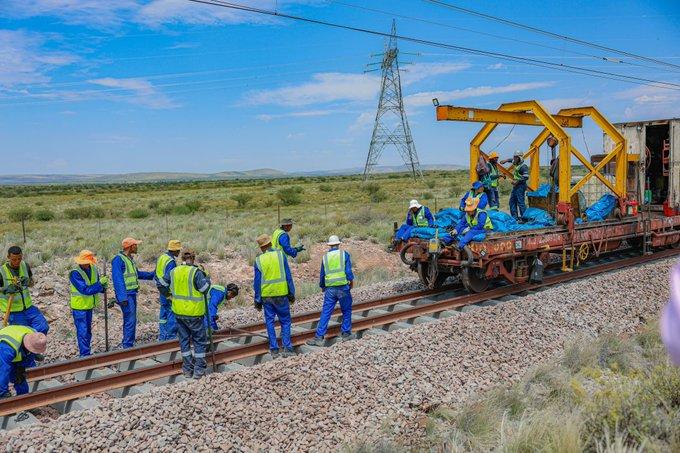
South Africa is investing R8.9 billion in restoring its 861-kilometre Iron Ore Export Line, a critical freight corridor connecting Sishen in the Northern Cape with the Port of Saldanha in the Western Cape.
The long-term Ore Line Restoration Programme, led by Transnet Rail Infrastructure Manager (TRIM) and running until 2030, aims to improve rail reliability, increase capacity and strengthen the country’s ability to transport iron ore to international markets.
Transport Minister Barbara Creecy outlined the investment during a site visit to the corridor on 12 October 2026, as part of the annual maintenance shutdown.
She said the railway was essential to South Africa’s mineral exports, industrial activity and employment across the logistics value chain. Reliable rail operations enable mines to move commodities efficiently, exporters to reach international customers and ports to handle cargo more effectively.
The annual maintenance shutdown, running from 6 to 16 October, provides an opportunity to carry out intensive work while regular rail operations are suspended. Activities include replacing rails and sleepers, screening ballast, maintaining turnouts, rehabilitating track formations and installing culverts. Electrical and signalling systems are also undergoing maintenance.
The work is intended to improve railway safety, operational reliability and long-term performance, helping restore the corridor’s ability to support export volumes.

Funding Targets Rail and Locomotive Reliability
Government has allocated R3.4 billion through the Budget Facility for Infrastructure (BFI) across the current and next financial years to support the restoration programme.
TRIM is expected to invest approximately R2.2 billion in restorative maintenance on the Ore Corridor during the current financial year, including R1.5 billion from the BFI allocation.
Transnet is also allocating R1.47 billion to maintain ore line rolling stock, comprising R752.3 million for wagons and R721.9 million for locomotives. Similar funding is planned for the next financial year.
The maintenance programme includes locomotive overhaul projects aimed at addressing accumulated maintenance backlogs and improving fleet availability, reliability and operational stability.
Rail improvements are being complemented by investment at the Port of Saldanha to strengthen the entire export chain, from mining operations to port infrastructure.
Saldanha Port Upgrade to Support Higher Export Volumes
At Saldanha, the Transnet National Ports Authority is commissioning the Bulk Power Upgrade Project, valued at approximately R750 million.
The project will increase the port’s electricity supply, enabling Transnet Port Terminals to operate its third tippler. The additional equipment is expected to support higher export volumes through the port.
The combined rail and port investments are intended to improve the efficiency of South Africa’s iron ore export corridor and strengthen its competitiveness in international commodity markets.
Maintenance Programme Creates Jobs for Local Businesses
The October maintenance intervention has created approximately 1,300 fixed-term contract opportunities, with more than 600 indirect opportunities expected through associated economic activity, according to Creecy.
The programme is also opening opportunities for small, medium and micro enterprises (SMMEs) supplying civil works, track maintenance services, logistics, transportation, plant and equipment support, materials, accommodation and related services.
Larger contractors can extend these benefits through local procurement and subcontracting, potentially helping businesses in communities along the railway corridor participate in infrastructure development.
Rail Restoration Supports South Africa’s Freight Reform
The investment forms part of the government’s broader effort to restore rail as the backbone of the country’s freight logistics system.
A central element of the reform programme is opening the freight rail network to private train operating companies while retaining state ownership of the infrastructure.
The establishment of TRIM provides a dedicated entity responsible for managing and maintaining the national rail network and facilitating access for operators. The Network Statement sets out the framework under which train operating companies can obtain access to the network.
Creecy said infrastructure investment would be essential to making rail reform effective, as private operators need confidence that the network will become safer, more reliable and more predictable.
Restoring the Iron Ore Export Line is therefore a key part of efforts to improve freight performance, support mining exports, create employment and strengthen South Africa’s position in global mineral supply chains.