


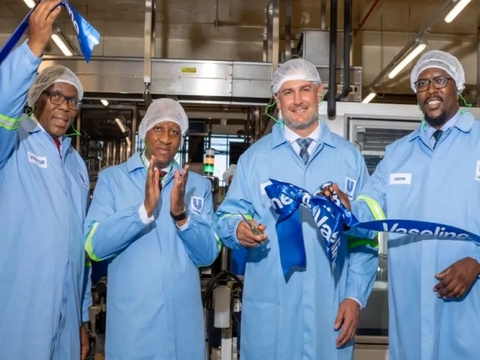
Unilever is investing R100 million (US$6 million) to expand Vaseline Petroleum Jelly production at its Maydon Wharf manufacturing facility in Durban, strengthening South Africa’s position as a regional and global manufacturing hub.
The new production line is designed to increase local manufacturing capacity, improve supply-chain resilience and support growing demand for Vaseline products across Africa and international markets.
Maydon Wharf currently supplies around 60% of Unilever’s global Vaseline Petroleum Jelly volumes. Following the expansion, the facility is expected to account for as much as 80% of the company’s global supply.
The investment represents a significant increase in the strategic importance of the Durban facility, positioning KwaZulu-Natal as an increasingly important base for the production and export of consumer goods.
Unilever Southern Africa CEO Stefan Cloete said the additional investment would strengthen the company’s ability to manufacture established brands locally while supporting employment, skills development and international exports.

The company also sees the investment as reinforcing South Africa’s role as a manufacturing platform capable of supplying both regional African markets and customers further afield.
Established in 1912, Maydon Wharf is one of the oldest facilities in Unilever’s global manufacturing network and was the company’s second manufacturing facility established worldwide.
The latest investment builds on the facility’s long-standing role while introducing additional production capacity to meet changing global demand.
The expansion comes as Unilever places greater emphasis on its major beauty, personal care and home care brands. The three divisions accounted for 75% of the company’s total turnover in the first half of 2026, while its power brands represented 78% of turnover and recorded 6% growth.
Vaseline has also been undergoing a broader brand development strategy aimed at making the long-established skincare brand more relevant to younger consumers and changing beauty trends.
For South Africa, however, the significance of the latest investment extends beyond Vaseline itself. Increasing production for global supply chains demonstrates how established manufacturing infrastructure can attract further capital investment while connecting local factories to international markets.
The Durban expansion also highlights the potential for South Africa to use its industrial base, logistics infrastructure and skilled workforce to serve as a manufacturing and export platform for multinational companies operating across Africa.
As global companies seek greater supply-chain resilience and more diversified production networks, investments such as the Maydon Wharf expansion could strengthen South Africa’s position in international manufacturing while creating opportunities for local suppliers, workers and service providers.
The R100 million investment therefore represents more than an expansion of a single production line. It is another indication that locally manufactured African products can increasingly serve markets well beyond the continent.