


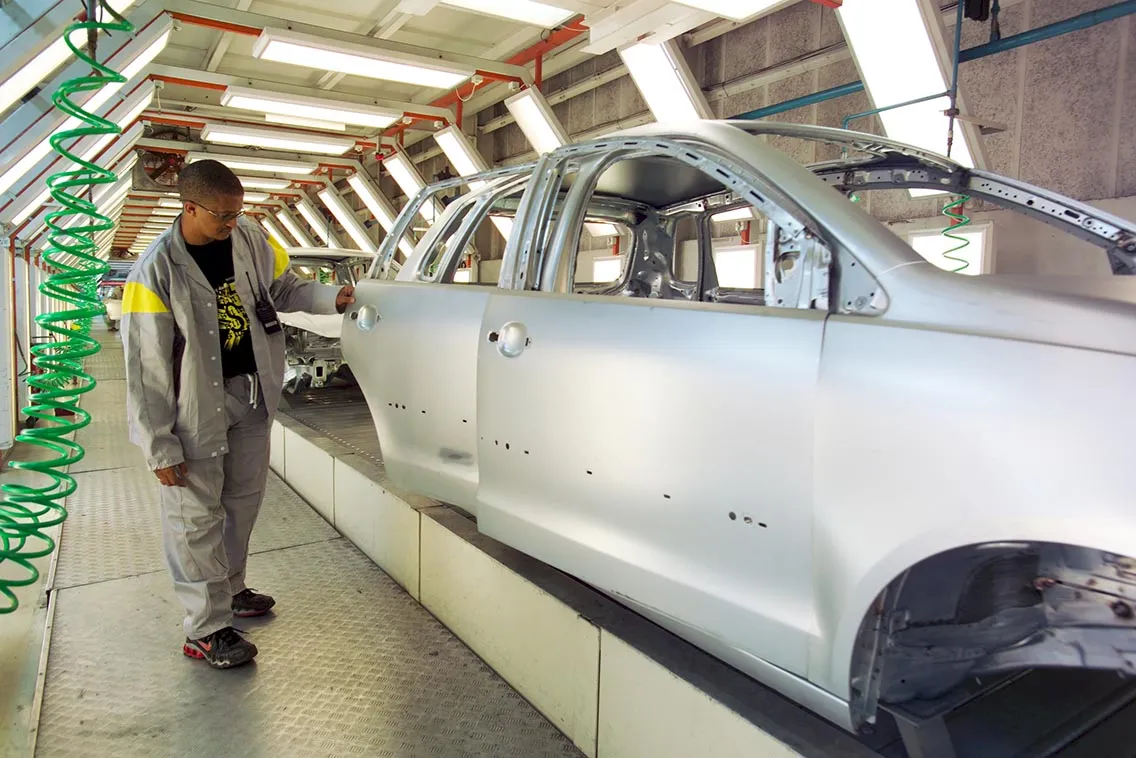
While African countries continue to export commodities such as copper, cobalt, cocoa, cotton and crude oil, a number of manufacturing centres are increasingly processing raw materials locally and producing vehicles, chemicals, food products, pharmaceuticals, machinery and other manufactured goods.
The African Development Bank’s Africa Industrialisation Index 2025 estimates that manufacturing value added across the continent increased from $285 billion in 2020 to $351 billion in 2025. Despite this growth, Africa still represents less than 2% of global manufacturing output and about 1.4% of global manufactured exports.
The gap highlights both the progress being made and the scale of the opportunity ahead.
Manufacturing is particularly important because local processing allows countries to retain more value from agricultural and mineral resources while creating jobs and supporting logistics, suppliers, services and other businesses around industrial centres.
Morocco Builds an Export-Oriented Automotive Industry

Morocco has emerged as one of Africa’s most prominent manufacturing success stories, particularly through its rapidly expanding automotive industry.
Renault and Stellantis have helped establish a network of more than 250 automotive and component companies. Morocco reached annual vehicle production capacity of around one million units in 2025, with a target of two million vehicles by 2030.
The country has also developed significant local manufacturing capacity. Local content in the automotive industry has reached approximately 69%, with Moroccan factories producing components including seats, wiring harnesses and tyres alongside finished vehicles.
Automotive exports reached a record 157 billion dirhams, equivalent to about $16.8 billion, in 2024.
Stellantis announced a €1.2 billion expansion of its Kenitra facility in 2025, which is expected to more than double production capacity to 535,000 vehicles annually. The plant produces conventional vehicles as well as smaller electric models.
Morocco is also positioning itself in the electric vehicle supply chain through plans for a Gotion battery gigafactory in Kenitra. The first phase is expected to provide annual capacity of 10GWh, with longer-term plans to reach 100GWh. The African Development Bank has approved $110 million in financing for the initial phase.
Morocco’s proximity to Europe, Tanger Med port, free trade agreements and industrial zones have helped integrate the country into international manufacturing supply chains, demonstrating that African factories can serve export markets well beyond the continent.
South Africa Remains a Major Industrial Base
South Africa has one of Africa’s broadest manufacturing economies, with industrial activity spanning Gauteng, Durban and the Eastern Cape.
The country produces vehicles, chemicals, steel, machinery, processed food, pharmaceuticals and other manufactured goods, with automotive production remaining one of its most important industrial activities.
South Africa produced 618,077 vehicles in 2025, with BMW, Ford, Isuzu, Mercedes-Benz, Nissan, Toyota and Volkswagen among the manufacturers operating locally. Vehicle exports reached a record 414,271 units, with Germany, the UK, France, Belgium and Italy among the major destinations.
Vehicle and component exports were worth a record R291 billion, or approximately $16 billion, in 2025 and represented 15.6% of South Africa’s total exports.
The automotive industry also accounted for 23.8% of manufacturing value added, while the broader automotive sector contributed 5.2% to GDP.
However, infrastructure and operating challenges continue to affect industrial competitiveness. Electricity constraints, congested ports and rail networks, high costs and weak investment have created pressure for manufacturers.
South Africa therefore illustrates another side of industrial development: building manufacturing capacity is only one part of the challenge. Maintaining competitiveness requires reliable infrastructure, efficient logistics and an investment environment capable of supporting long-term production.
Kenya Targets Regional Manufacturing Demand
Kenya’s manufacturing sector is closely linked to both its domestic market and neighbouring economies within the East African Community.
The industrial corridor between Nairobi and Mombasa supports food and beverage processing, cement, pharmaceuticals, plastics, chemicals, steel products and consumer goods.
Food processing remains particularly important, with tea and coffee processing, flour milling, edible oils, brewing and packaged foods helping convert agricultural production into higher-value products.
Companies such as East African Breweries, Bidco Africa and Unga Group have built significant businesses around domestic and regional demand.
Construction materials are another important part of Kenya’s industrial base. Construction expanded by 6.8% in 2025 after contracting by 0.7% in 2024, while mining and quarrying increased by 14.9%, partly reflecting stronger production of minerals used in cement manufacturing.
Kenya has also developed one of sub-Saharan Africa’s more established pharmaceutical manufacturing industries, although the sector remains dependent on imported finished medicines and active pharmaceutical ingredients.
With a population of more than 50 million and access to neighbouring East African markets, Kenya demonstrates the importance of domestic and regional demand in supporting manufacturing investment.
Egypt Combines Domestic Demand With Export Potential
Egypt benefits from a population of more than 100 million, access to the Suez Canal, major ports and proximity to Europe, the Middle East and Africa.
Its manufacturing base includes chemicals, fertilisers, steel, cement, processed food, textiles, pharmaceuticals and electrical equipment.
The scale of Egypt’s exports demonstrates that its factories are not focused solely on replacing imports. The country exported goods worth $26 billion during the first half of 2025, representing a 19% increase from the same period in 2024.
Ready-made garments generated $1.6 billion in exports during the period, while fertilisers accounted for $1.4 billion, food preparations and pasta $1.1 billion, and primary-form plastics about $790 million.
However, manufacturers continue to face challenges including access to foreign currency, imported machinery and components, energy reliability, financing and economic uncertainty.
Egypt highlights the fact that manufacturing growth requires more than factories. Businesses also need stable operating conditions and access to the capital and inputs required to keep production lines running.
Nigeria Uses Scale to Drive Industrial Growth
Nigeria offers a different manufacturing model, built around the size of its domestic market.
With a population of about 242 million, the country has a large consumer base for food, beverages, cement, construction materials and other products. Real manufacturing growth reached 3.29% year-on-year during the first quarter of 2026.
Cement is among Nigeria’s strongest industrial sectors. Dangote Cement has production capacity of 32.25 million tonnes annually in Nigeria and 55 million tonnes across Africa. The group sold 27.5 million tonnes of cement and clinker in 2025, generating revenue of N4.31 trillion.
Bua Cement and Lafarge Africa provide additional competition, while Nigeria has developed large food and beverage industries covering brewing, flour milling, sugar refining, noodles and packaged foods.
The country’s industrial ambitions have also expanded into energy and petrochemicals.
The $20 billion Dangote Petroleum Refinery near Lagos has capacity to process 650,000 barrels of crude oil per day. Its development is significant for an economy that historically exported crude oil while importing large quantities of refined petroleum products.
The refinery’s planned petrochemical activities could also create feedstock for additional manufacturing industries.
Nigeria’s manufacturers nevertheless face unreliable electricity, congested ports, high financing costs and currency volatility. The depreciation of the naira increased the cost of imported machinery and raw materials, while simultaneously encouraging some companies to source more inputs locally.
Some manufacturers have responded by increasing domestic sourcing. Chemical and Allied Products, for example, obtains about 90% of its calcium carbonate locally, while the share of domestic raw materials used across Nigerian manufacturing has risen above 57%.
Turning Manufacturing Success Into African Supply Chains
The experiences of Morocco, South Africa, Kenya, Egypt and Nigeria demonstrate that there is no single path to industrialisation in Africa.
Morocco has used infrastructure and access to European markets to develop an export-oriented automotive industry. South Africa has built on decades of industrial capabilities. Kenya is using domestic and regional demand to expand manufacturing, while Egypt combines a large consumer market with export opportunities. Nigeria is attempting to use its population and resource base to develop deeper industrial capacity.
The African Continental Free Trade Area could help connect these different manufacturing centres by creating a larger market and encouraging cross-border supply chains.
A continental market of more than 1.4 billion people could give manufacturers greater opportunities to achieve economies of scale while allowing components, raw materials and finished products to move between African economies.
However, tariffs are only one part of the industrialisation challenge. Manufacturers also require reliable electricity, efficient ports and railways, affordable financing, skilled workers and competitive local suppliers.
Africa’s next phase of manufacturing development will therefore depend not only on building more factories, but also on developing increasingly sophisticated industries.
Morocco’s move from vehicle assembly into components and electric vehicle batteries provides one example of how manufacturing can progress towards higher-value activities.
The wider challenge for Africa is to connect individual industrial successes into regional production networks in which raw materials are processed locally, components move between manufacturing centres and finished goods reach consumers across the continent and international markets.
That would turn “Made in Africa” from an industrial ambition into a more integrated trade and manufacturing strategy.