


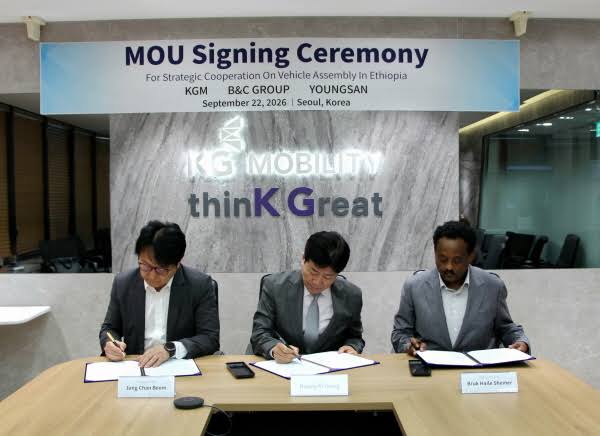
South Korean automaker KG Mobility (KGM) is establishing an electric vehicle assembly plant in Ethiopia as part of a strategy to expand its presence across East Africa and develop the country as a regional export hub.
KGM has signed a memorandum of understanding with Ethiopia’s B&C Manufacturing Group and Youngsan Glonet to develop a knockdown (KD) assembly operation. Construction is scheduled to begin in October, with production expected to start during the first half of 2027.
The plant is planned to have an initial annual production capacity of approximately 1,000 vehicles, including KGM’s Torres EVX and Musso EV electric models.
Vehicles assembled in Ethiopia will be sold domestically, while B&C Manufacturing Group plans to export units to markets including Somalia, Kenya, Uganda, Rwanda and Djibouti.
The project is designed to position Ethiopia as a production and distribution base for KGM’s expansion across East Africa, rather than serving only the country’s domestic vehicle market.

Under the partnership, B&C Manufacturing Group will secure the plant site and infrastructure and oversee construction. Youngsan Glonet will provide plant design, engineering and technical consulting services, as well as production equipment, while KGM will supply vehicles and components required for local assembly.
The knockdown model involves shipping vehicles and components separately for assembly in the destination market. This approach can help manufacturers manage tariff barriers, meet local production requirements and establish a manufacturing presence without initially building a fully integrated vehicle production facility.
KGM CEO Hwang Ki-young said the company intends to expand its KD operations into Saudi Arabia and Vietnam during the year as it increases its focus on emerging markets.
Ethiopia is being positioned as an important part of that strategy because of its large domestic market and access to neighbouring East African economies. Establishing local assembly could also give KGM greater flexibility to adapt its sales and distribution strategy to individual markets.
The initial capacity of about 1,000 vehicles annually is relatively small, meaning the immediate contribution to KGM’s overall sales is expected to be limited. However, the Ethiopian operation gives the automaker an opportunity to establish a local production base, build market knowledge and develop distribution networks before potentially increasing volumes.
The move comes as automakers increasingly explore local assembly as a way to enter emerging markets, particularly where imported fully built vehicles face higher tariffs or other market-access barriers.
Africa’s electric vehicle market remains at an early stage, but manufacturers are increasingly monitoring the continent’s longer-term potential as governments pursue cleaner transport and emissions-reduction strategies.
For Ethiopia and its regional neighbours, the KGM investment could also contribute to the development of local automotive skills, supporting services and cross-border vehicle trade.
If the initial operation proves successful, the Ethiopian plant could provide a platform for KGM to increase production and broaden its electric vehicle presence across East Africa, strengthening the region’s role in emerging EV supply chains.