


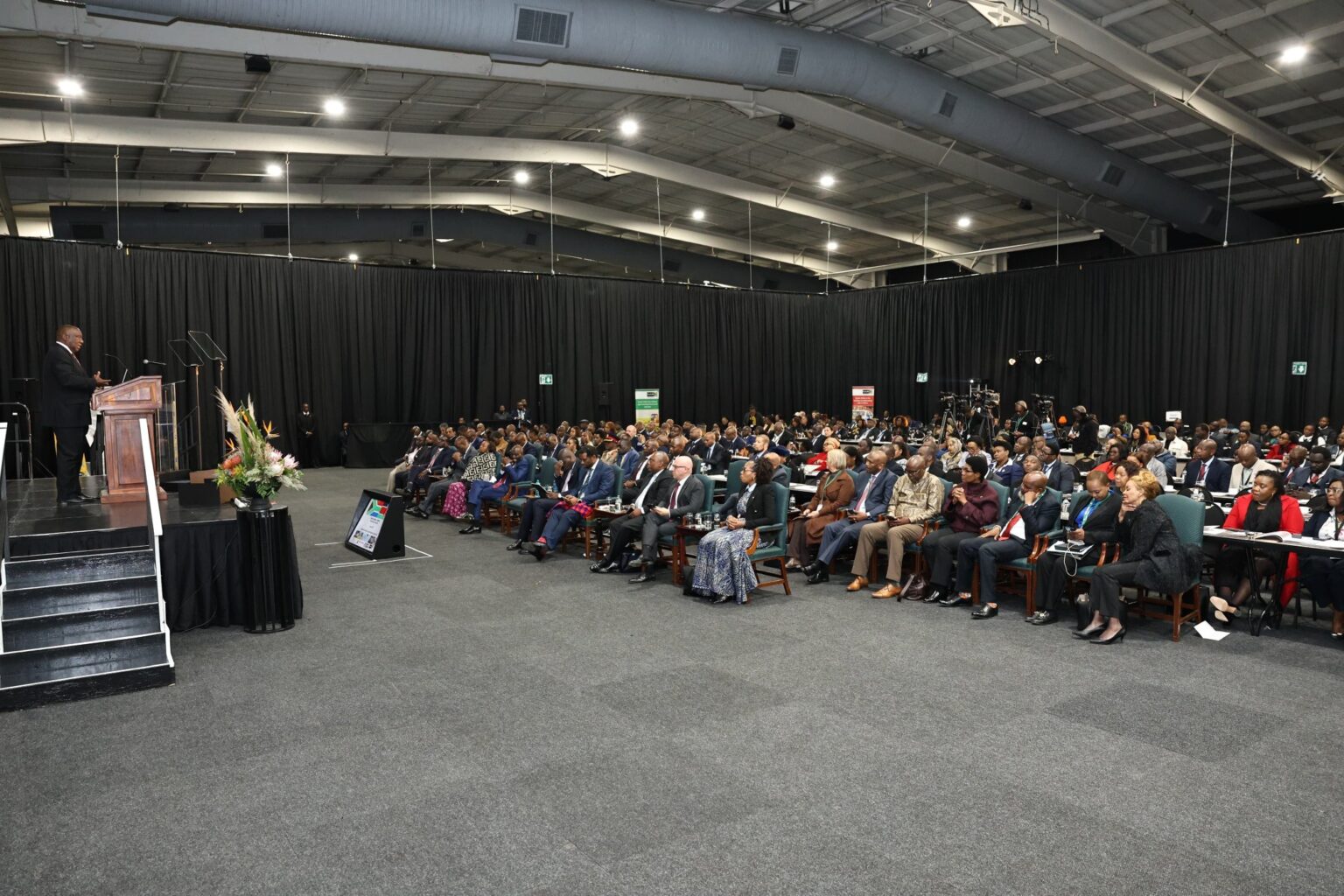
MIDRAND, SOUTH AFRICA – South Africa and Kenya have renewed calls for stronger economic integration across Africa, with leaders and business executives emphasizing the need to transform trade agreements into tangible industrial growth, investment, and job creation.
The message emerged during the South Africa-Kenya Business Forum held at the Gallagher Convention Centre in Midrand as part of Kenyan President William Ruto’s state visit to South Africa.
While both governments reaffirmed their commitment to regional trade and investment, business leaders stressed that practical barriers such as customs delays, regulatory duplication, visa restrictions, and non-tariff barriers continue to limit the full benefits of the African Continental Free Trade Area (AfCFTA).
South African President Cyril Ramaphosa said the future of African growth lies in collaboration rather than competition, urging countries to build integrated value chains that support manufacturing and value addition across the continent.
“We have moved beyond what we can sell to each other and towards what we can build together,” Ramaphosa told delegates.

Kenyan President William Ruto echoed the sentiment, highlighting opportunities for cooperation in manufacturing, agriculture, mining, logistics, pharmaceuticals, digital services, renewable energy, and green industrialisation.
The two leaders noted that South Africa and Kenya occupy strategic positions within the continent’s economy. Kenya serves as a gateway to East and Central Africa, while South Africa remains the continent’s most industrialised economy and a leading financial hub.
Despite these advantages, trade between the two countries remains relatively modest. Bilateral trade reached approximately US$680 million in 2025, with South African companies accounting for more than US$2 billion in investments in Kenya, while Kenyan firms have invested an estimated US$283 million in South Africa.
Business leaders argued that unlocking greater trade and investment will require accelerated implementation of existing agreements rather than additional policy commitments.
Standard Bank Group Chief Executive Sim Tshabalala described Kenya and South Africa as the “bookends” of a major north-south economic corridor stretching from the Port of Mombasa to Cape Town. However, he noted that intra-African trade remains significantly below levels achieved in Europe and Asia.
According to Tshabalala, Africa accounts for only about 17 percent of its own exports through intra-regional trade, compared with 59 percent in Asia and 69 percent in Europe.
Industry representatives called for continent-wide customs modernisation, harmonised standards, simplified visa requirements for business travellers, and faster implementation of AfCFTA provisions.
The forum also highlighted the importance of industrialisation and value addition as Africa seeks to reduce dependence on raw commodity exports. Delegates emphasized the need to develop regional manufacturing networks, agro-processing industries, mineral beneficiation projects, and integrated supply chains capable of supporting long-term economic growth.
For the agricultural sector, stronger South Africa-Kenya cooperation could create new opportunities in grain trade, agro-processing, food manufacturing, and regional food security initiatives. Participants noted that reducing non-tariff barriers would allow agricultural products to move more efficiently between markets and strengthen regional supply chains.
Business Unity South Africa Chairperson Stavros Nicolau said Africa’s industrial ambitions must be matched by regulatory efficiency and faster implementation of trade reforms.
Delegates agreed that the success of African integration will ultimately be measured not by the number of agreements signed, but by factories built, investments secured, goods traded, and jobs created.
As the AfCFTA enters its implementation phase, South Africa and Kenya are positioning themselves as key partners in advancing a more integrated and industrialised African economy.